
Retro Time: Vintage Table Clocks to Complete Your Bedside Table
The last thing you see before sleep shouldn't be a notification. We explore how the humble table clock is making a comeback as the ultimate bedside anchor, blending retro charm with modern mindfulness.

Let's be honest for a second: when was the last time you went to bed without checking your phone? The blue light floods your retinas, the endless scroll hijacks your dopamine, and suddenly, a "quick check" turns into an hour of lost sleep. We treat our bedside tables as charging stations for our anxieties rather than sanctuaries for rest. But there is a quiet rebellion happening in bedroom design right now—a return to the analog. It’s not just about telling time; it’s about reclaiming your attention.
Contents

The Analog Rebellion: Why You Need a Clock, Not a Phone
There is a specific kind of peace that comes from a room without screens. Imagine waking up and, instead of being immediately bombarded by emails, news alerts, and other people's curated lives, you simply see... time. Just time. Quiet, unjudging, and patient. Choosing a vintage table clock aesthetic over a smartphone alarm isn't just a styling choice; it's a mental health strategy disguised as decor.
This shift is rooted in the concept of "environmental cues." When your brain sees a phone, it anticipates work, social pressure, and dopamine hits—all of which are enemies of deep sleep. A clock, however, has a singular, humble purpose. It anchors the room in the physical world. It tells you that here, in this space, time is yours to spend, not yours to lose. By replacing the sleek black mirror of a screen with the warm texture of wood, ceramic, or retro plastic, you are physically building a boundary between the chaos of the world and the sanctuary of your sleep.
But let's not pretend aesthetics don't matter. A bedside clock is one of the few objects you interact with intimately every single day. You touch it in the dark; it's the first thing you see in the morning. It deserves to be beautiful. It deserves to be a piece of functional art that sparks a tiny moment of joy before your feet even hit the floor.
Sculptural Silence: The Wood & Geometry Edit
If your bedroom leans towards the Japandi or minimalist end of the spectrum, you know that every object needs to earn its keep. Clutter is the enemy of calm. This is where the clock transcends functionality and becomes sculpture. We aren't looking for a machine that shouts the time; we are looking for a form that whispers balance.
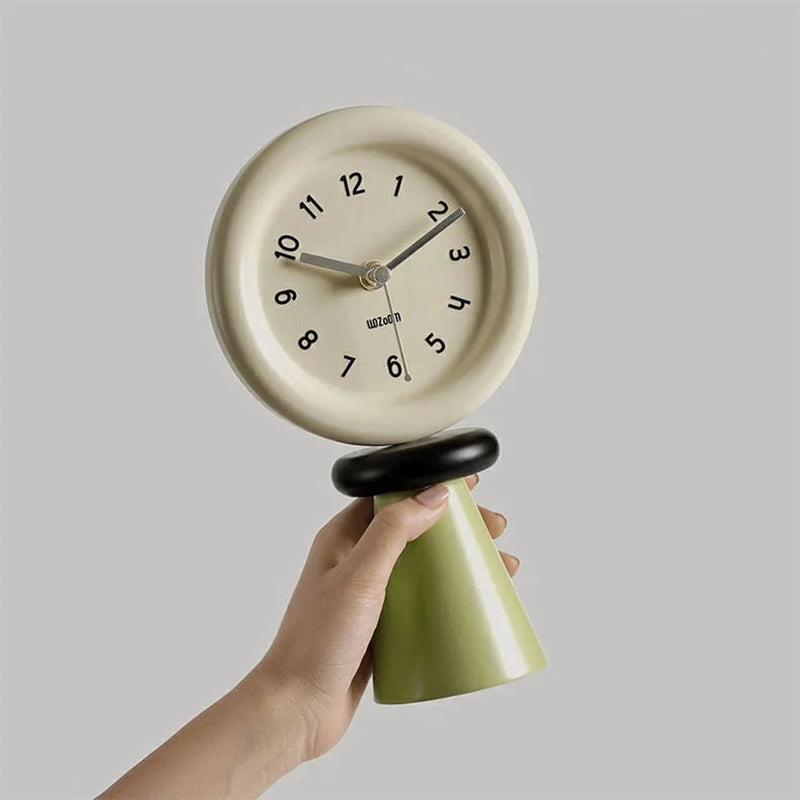
The Art of Balance
Consider the Sculptural Two-Tone Wood Table Clock. It defies the traditional "box on a stand" design. Instead, it presents a study in geometry: a perfect cream circle balanced precariously, yet securely, on a sage green cone. It feels less like an appliance and more like a mobile from a modern art gallery frozen in time.
The Cinematic Still: Imagine the early morning light filtering through sheer curtains, hitting the side of your nightstand. The light catches the curve of the clock’s wooden face, revealing the subtle, organic grain beneath the paint. It’s a soft, diffused moment. The sage green base doesn't just sit there; it roots the object, recalling the trunk of a tree or the stem of a mushroom. In this freeze-frame, the clock isn't ticking away your life; it's holding space. It reminds you of a Brancusi sculpture—simple, essential, and devoid of unnecessary noise. The silence of its non-ticking mechanism ensures that this visual serenity is matched by auditory peace.

Ceramic & Soul: The Tactile Experience
There is something grounding about ceramic. It carries the weight of the earth. Unlike plastic which feels temporary, or metal which can feel cold, ceramic holds a unique temperature—cool to the touch, yet visually warm. In a bedroom setting, introducing ceramic textures adds a layer of sophistication that feels "lived-in" and intentional.


The Cutout Playfulness
The Smooth Minimalist Cutout Ceramic Clock invites you to touch. It plays with the concept of "negative space" quite literally. The numbers aren't painted on; they are carved into the body of the clock, creating depth and shadow that changes as the day progresses.
Tactile Synesthesia: Run your fingers over the surface. It’s not the glassy, slippery feel of a glazed mug, but a smooth, matte finish that feels like a polished river stone or a piece of high-quality unglazed porcelain. It has a "drag" to it that feels premium. When you reach out in the semi-darkness to check the time, your fingertips might graze the indented curve of the number '3'. That physical sensation—the dip in the surface—grounds you. It triggers a sense of permanence. It’s a small, sensory reminder that you are in a safe, solid place, far away from the ephemeral scrolling of a touchscreen.
The Architectural Arch
On the other hand, the Matte Arch Ceramic Table Clock brings a different energy: architectural silence. Its shape mimics the arches found in Roman aqueducts or modern alcoves, creating a sense of shelter.
Negative Space Philosophy: Bedside tables are often small and crowded. This clock solves the "visual noise" problem by using a folded, bridge-like structure. It doesn't block the view; it frames it. The space underneath the arch allows the table surface to flow through, preventing the setup from feeling heavy or blocky. It sits there like a small monument to patience. The matte speckles on the ceramic surface act like visual white noise—gentle, non-demanding, and perfectly imperfect. It’s the visual equivalent of a deep breath.


Retro Pop & Mid-Century Nostalgia
Sometimes, the best way to move forward is to look back. The "Retro Pop" and "Light Academia" aesthetics rely on objects that feel like they have a history, even if they are brand new. These clocks act as time machines, transporting the vibe of your room to a 1960s design studio or a 1980s teenage bedroom.
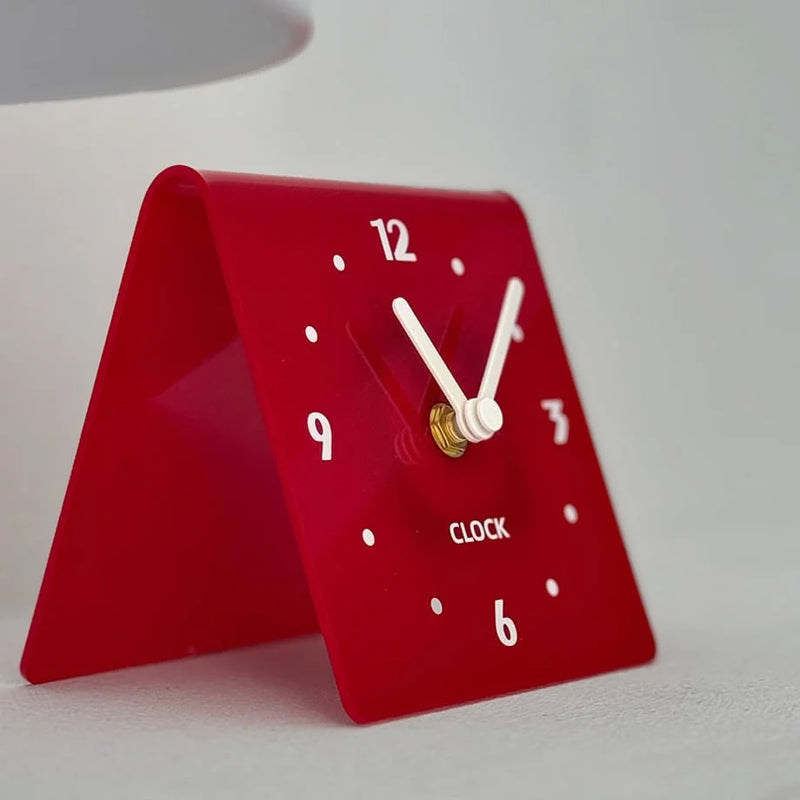
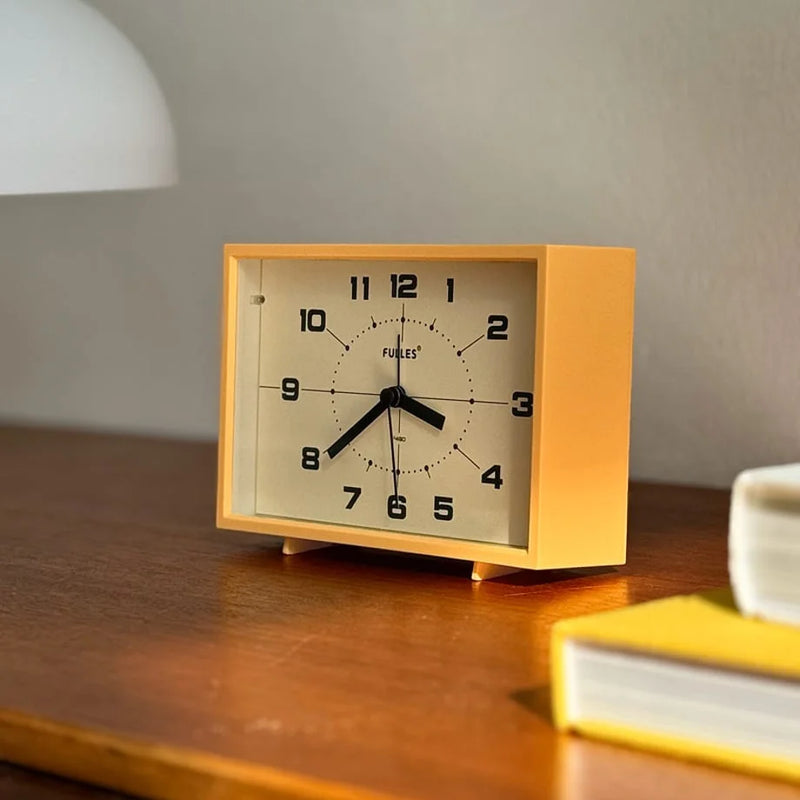
The Light Catcher: The Sleek Minimalist Metal Table Clock is all about the interaction with light. Unlike the matte ceramics, this piece wants to be seen. Its high-gloss finish acts like a mirror to your room's mood. When you turn on your warm bedside lamp, the folded metal face captures that amber glow and stretches it across its surface, creating a liquid-like reflection. The bold red variant is a "Style Anchor"—in a room full of beige and cream, it screams confidence. It says, "I am the focal point." It’s folded like a piece of origami but possesses the cold, industrial coolness of steel.
The Memory Trigger: In contrast, the Matte Retro Analog ABS Clock works on a psychological level. The rectangular shape, the specific font of the numerals, the slight recess of the face—it all triggers a specific memory. It smells like old library books and pencil shavings. It reminds you of the clock on the wall in elementary school, or the one on your grandfather's desk. This isn't just retro styling; it's emotional engineering. But unlike the ticking time bombs of the past, this one has been updated with a silent sweep movement. It keeps the aesthetic of the past but leaves the anxiety there. Plus, the gentle night light is a thoughtful touch—a soft, warm glow that respects your melatonin levels, unlike the harsh blue flash of a phone screen.


Styling Your Sanctuary: The Bedside Vignette
Buying the clock is step one. Styling it is where the magic happens. A clock shouldn't float in a void; it needs companions to tell a story. We call this the "Bedside Trinity": Time, Light, and Soul.
The Strategy: Start with the clock as your anchor. If you chose the Wood Sculptural Clock, pair it with a stack of two matte hardcover books (neutral spines facing out) and a small glass vase with a single dried branch. The wood connects with the paper, and the glass adds lightness. If you went with the Red Metal Clock, let it stand alone next to a curvaceous mushroom lamp. The sharp lines of the metal need the softness of the light to balance the energy. For the Ceramic Arch, try placing it on a small linen coaster or a piece of slate. The contrast of textures—fabric vs. ceramic—creates a micro-landscape that is visually satisfying to wake up to.

Ultimately, this is about more than just telling time. It's about setting a boundary. It's about deciding that your bedroom is a place for dreams, not feeds. When you invite one of these pieces into your space, you aren't just decorating; you're making a promise to yourself to slow down, disconnect, and rest. And in today's world, that is the ultimate luxury.


