
Wabi-Sabi Vases: How to Style the 'Perfectly Imperfect' Look
Is your home feeling too 'curated'? It’s time to embrace the flaw. We explore how the quiet philosophy of Wabi-Sabi and Japandi design can transform your space using sculptural vessels that celebrate the perfectly...

There is a specific kind of exhaustion that comes from scrolling through Instagram feeds of pristine, white-box apartments. You know the ones: where the pillows are karate-chopped to perfection, the surfaces are devoid of life, and you get the distinct feeling that if you were to walk in, you’d be afraid to exhale. It feels sterile. It feels performative. But recently, the pendulum has swung. We are collectively craving something that feels real. Something that has a pulse.
Enter Wabi-Sabi. It’s not just a design trend; it’s a deep exhale for your home. Rooted in Japanese philosophy, it is the art of finding beauty in imperfection, impermanence, and authenticity. It’s the crack in the ceramic bowl that is filled with gold; it’s the linen sheet that looks better wrinkled; it’s the vase that looks like it was shaped by human hands, not a machine. Today, we aren't just talking about decorating. We are talking about how to use wabi sabi home decor principles—specifically through the lens of sculptural vessels—to turn your space from a showroom into a sanctuary.
Contents

The Sculptural Silence: Faces of Calm
In a world that is constantly shouting for your attention, there is profound power in an object that simply exists in silence. The first step in achieving a Wabi-Sabi aesthetic is to introduce objects that feel like they have a soul—pieces that blur the line between utility and sculpture. We often think of vases as mere containers for flowers, but in the Wabi-Sabi tradition, the vessel itself is the protagonist. It doesn't need a bouquet to justify its existence; its form is enough.
Consider the psychological impact of introducing abstract human forms into your living space. It taps into a primal connection we have with the human figure, but by abstracting it—removing the hyper-realistic details and leaving only the suggestion of a face or a body—we create a space for projection and introspection. These aren't just decorations; they are silent roommates that hold space for quiet contemplation. The matte finish is crucial here. Unlike glossy surfaces that reflect the world back at you, matte surfaces absorb light, drawing the eye inward and creating a sense of grounding softness.
To execute this look, you need to treat your console table or bookshelf not as storage, but as a curated gallery. The goal is to create a vignette that invites the eye to travel slowly. Place a sculptural vase slightly off-center. Leave empty space around it—what the Japanese call Ma (negative space). This emptiness is not a lack of stuff; it is a luxury. It allows the object to breathe and allows you to appreciate the subtle irregularities of its form.

Imagine a late Sunday afternoon. The light is fading, casting long, lazy shadows across your room. Sitting on your sideboard is the Matte Abstract Face Ceramic Vase. It doesn't scream for attention. Instead, its frosted, stone-like surface catches the waning light in a soft gradient, highlighting the gentle curve of the abstract nose and the meditative shut eye. It feels ancient and modern all at once, like a relic from a civilization that valued peace above all else. In this moment, stripped of colorful bouquets, standing alone against a bare wall, it transforms the corner of your room into a scene from a quiet indie film—a pause button pressed on the chaos of the week.
But the human form in clay offers more than just faces. It offers the vulnerability of the body itself. The Sculptural Body Form Ceramic Vase takes this narrative further. With its Dove Grey glaze and raw, rock-like base, it embodies the Wabi-Sabi embrace of contrasting textures—the smooth against the rough, the refined against the raw.
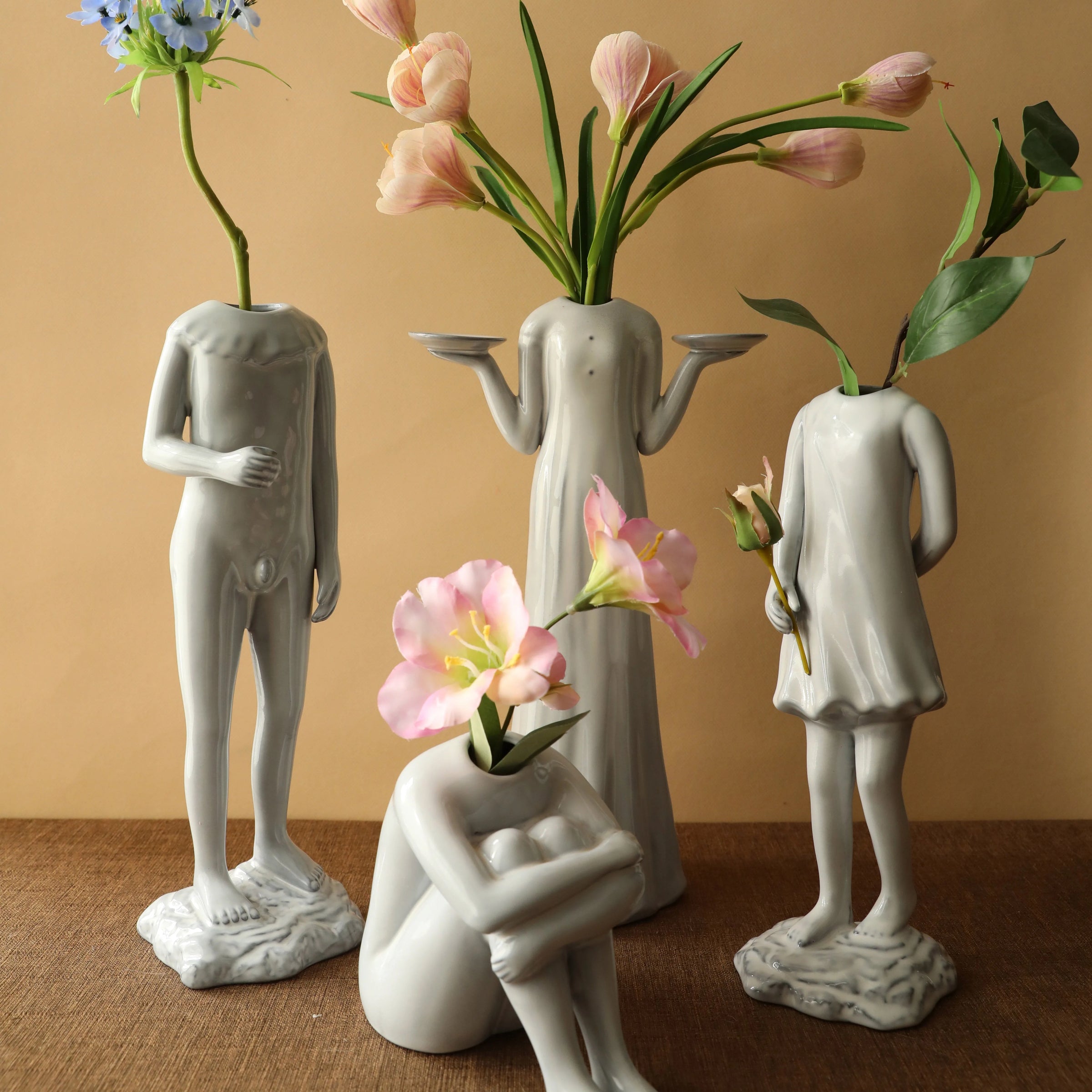
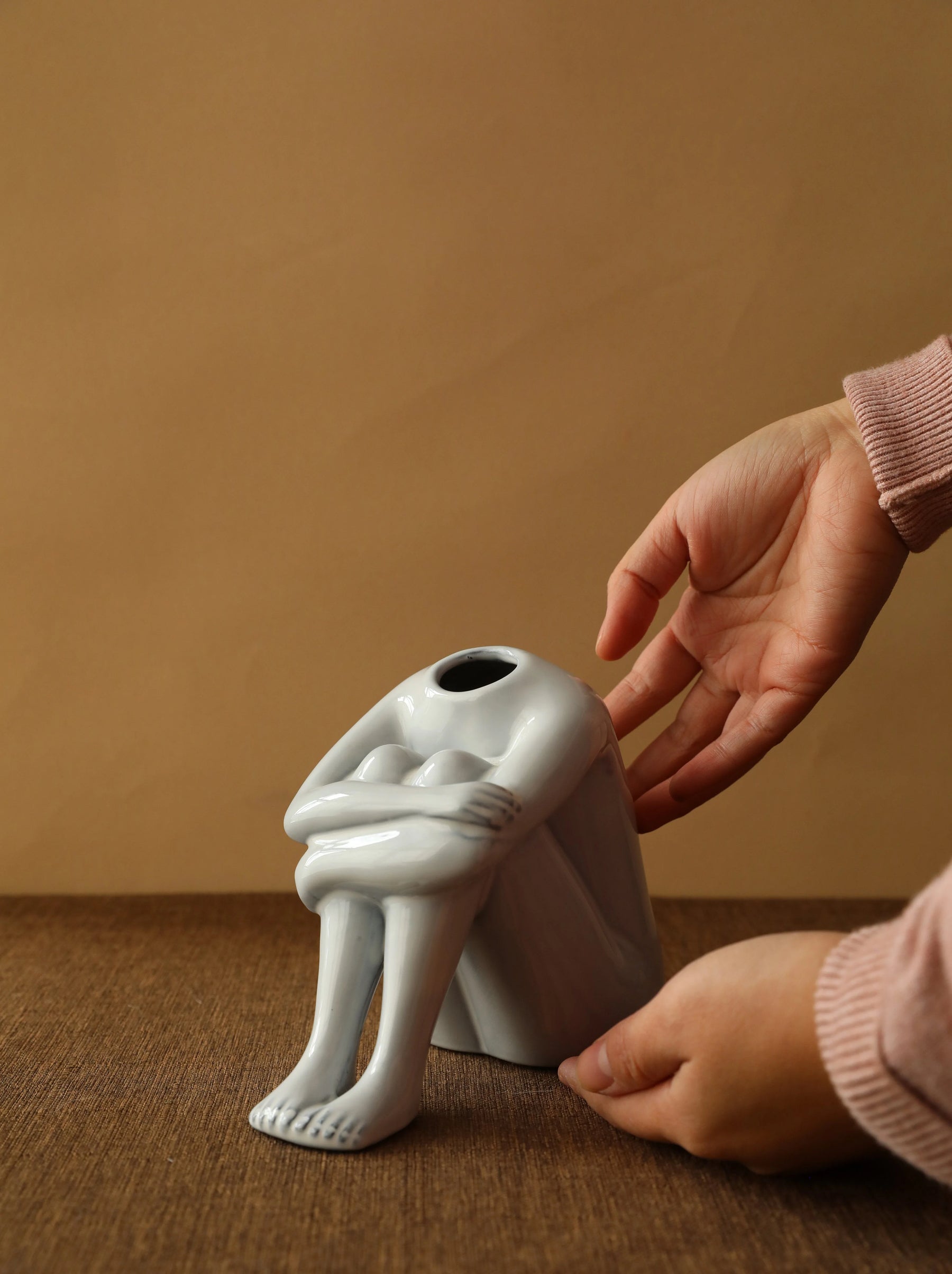
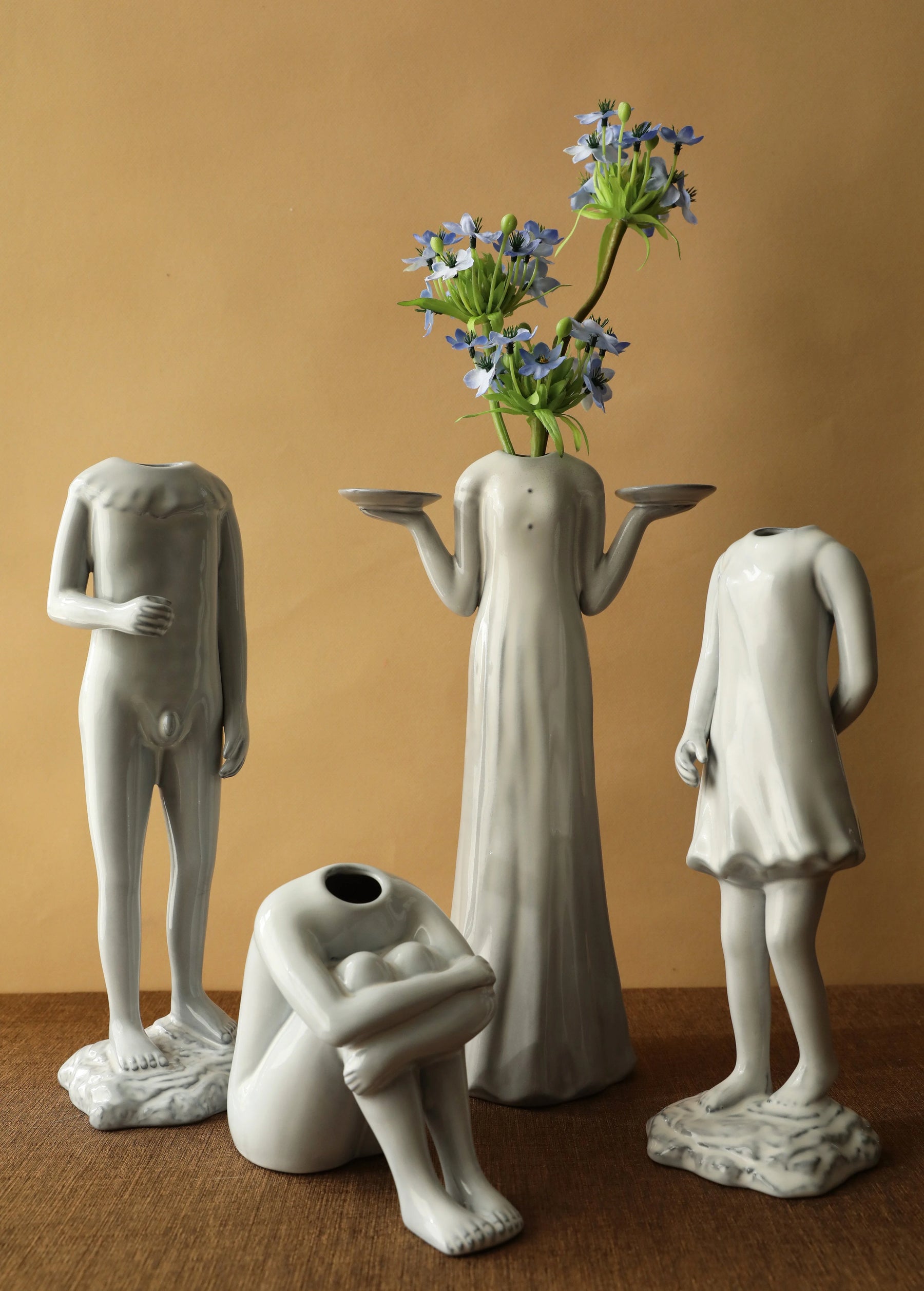
There is a distinct "Museum Quality" to these pieces. When you place a single, dried stem of pampas grass into the neck of the figure, it stops being a vase and becomes an installation. It evokes a sense of "The Thinker" meets modern minimalism. The raw base grounds it, reminding us of the earth it came from, while the smooth body reaches upward. It creates a dialogue about resilience and softness that resonates deeply in a personal space.
The Art of the Crumple: Celebrating Process
One of the core tenets of Wabi-Sabi is the appreciation of the "accident" or the evidence of time and force. Usually, we try to smooth out wrinkles, iron out creases, and hide any sign that a material has been handled. But there is a rebellious beauty in the crumple. It signifies a moment in time captured forever—a freeze-frame of action.
Texture as Narrative
Why are we drawn to the shape of a paper bag? It’s humble. It’s disposable. It’s the antithesis of luxury. Yet, when that form is immortalized in high-quality frosted ceramic, it creates a fascinating cognitive dissonance. Your brain expects the fragility of paper, but your hand meets the cool, solid weight of ceramic. This is "High-Low" aesthetic alchemy at its finest. It tells a story of elevating the mundane, of finding art in the trash can, of seeing the sculpture in the grocery run.

We need to talk about the "flaw" as a feature. The Ruched Frosted Ceramic Vase doesn't apologize for its dented sides or its irregular mouth. In fact, it flaunts them. The frosted matte finish is key here—it diffuses light across the ridges and valleys of the "crumples," creating a complex landscape of shadows that changes throughout the day. If this vase were glossy, the reflections would hide the form; because it is matte, the light clings to every curve. It feels almost soft to the eye, like suede, inviting you to reach out and trace the ridges, reaffirming that imperfection is tactile, interesting, and real.
Color as Mood
While Wabi-Sabi often leans into beiges and greys, it doesn't reject deep, soulful color. The key is in the saturation and the finish. A deep midnight blue, when rendered in a matte texture, becomes infinite. It absorbs the room's energy and calms it down.

This Frosted Ruched Ceramic Paper Bag Vase in blue serves as a visual anchor. Place it on a light oak table, and the contrast is striking yet harmonious. The "crumpled" design catches the light in a way that mimics the movement of water or fabric. It’s a piece that proves minimalism doesn't have to be boring—it just has to be thoughtful. When you fill it with bright sunflowers or wildflowers, the contrast between the industrial "paper bag" shape and the organic chaos of nature creates a vignette that feels effortlessly curated, like a snapshot from a Copenhagen artist's loft.
Organic Friction: When Rattan Meets Glass
Texture is the secret language of Wabi-Sabi. It is the friction that stops the eye from sliding off a surface too quickly. One of the most effective ways to introduce this "good friction" is through mixed materials. The juxtaposition of materials tells a story of balance: the fragility of glass supported by the resilience of woven fiber.
This combination works because it triggers a "tactile synesthesia"—you can feel the object just by looking at it. The clarity of the glass represents air and light, while the rattan represents earth and wood. Bringing them together in a single object creates a microcosm of the natural world on your tabletop. It bridges the gap between the sleekness of modern design and the rustic warmth of cottagecore, making it the ultimate transitional piece.


Close your eyes and imagine running your fingers over the Handwoven Rattan & Glass Bud Vase. First, you meet the cool, smooth resistance of the glass neck—clinical, perfect, cold. Then, your fingers slide down to the rattan sleeve. Suddenly, there is warmth. There is the coarse, dry texture of dried palm stems, the slight irregularity of the hand-weave, the smell of dried grass and sunshine. It’s a sensory journey in three inches. This vase doesn't just hold a flower; it grounds it. Placing a single, delicate stem into this vase feels like planting it back into the earth. It brings a rustic honesty to a marble counter or a glass table, softening the hard edges of modern living.
Light Catchers: The Void and The Volume
Sometimes, Wabi-Sabi is about what isn't there. It is about transparency, light, and the way a physical object can seem to disappear, leaving only a tint of color in the air. Glass, especially tinted glass, acts as a filter for reality. It doesn't block the view; it softens it.
The concept here is "atmospheric volume." A solid ceramic vase occupies space; a glass vase defines it without consuming it. This is crucial for smaller spaces or cluttered corners where you need decor that feels weightless. The tint—whether smoky grey or amber—adds a layer of moodiness, like putting a vintage filter on a photograph. It changes the quality of the light passing through it, casting colored shadows that move with the sun.


When the morning sun hits the Minimalist Tinted Oval Glass Vase, something magical happens. The Smoky Grey version doesn't just sit there; it holds the light, turning it into a cool, mysterious vapor within the glass walls. The edges of the vase seem to glow, creating a halo effect. It reminds you of looking through rain-streaked windows or the surface of a deep lake. It brings a water-element energy to the room—fluid, clear, and cleansing. Paired with a simple branch, it captures the essence of Ikebana: the appreciation of line and form over abundance.
The Playful Soul: Minimalism with a Wink
There is a misconception that Wabi-Sabi and Japandi styles must be serious, somber, and beige. But joy is a fundamental part of a lived-in home. The "perfectly imperfect" philosophy also applies to personality—we are quirky, weird, and expressive beings, and our homes should reflect that. You can maintain a serene palette while introducing shapes that make you smile.
This is where the "Character Object" comes in. These are small, unobtrusive pieces that reward close attention. From a distance, they look like simple geometric forms—a sphere, an arch, a cylinder. But up close, a tiny face emerges. It’s a design secret shared between the object and the observer. It breaks the pretension of high design and reminds us not to take our decor too seriously.


Imagine hosting a dinner party. The vibe is chill, the music is low. A guest leans over to pick up their wine glass and suddenly spots the Frosted Minimalist Face Ceramic Vase sitting quietly by a stack of books. They stop. They smile. "Look at this little guy," they say. The tiny, minimalist face—just two dots and a line—conveys so much emotion with so little effort. It feels like a silent guardian of the vibe, a little spirit of the house. The frosted texture begs to be touched, feeling like a smooth river stone. It’s not just a vase; it’s a social lubricant, a spark of joy, a tiny friend on your shelf that says, "It's okay to be playful."
The Modern Interruption: Breaking the Rules
Finally, a note on contrast. While we love the muted and the matte, a true Wabi-Sabi home is eclectic. It reflects the gathered nature of a life well-lived. Sometimes, to appreciate the calm, you need a little bit of chaos. You need a "Style Anchor" that disrupts the peace just enough to make it interesting.
While the rest of your collection whispers, the Glossy Harlequin Striped Ceramic Vase sings. It’s the rebel in the room. Introducing one high-gloss, patterned piece into a matte, neutral space creates a vibration of energy. It prevents the room from feeling flat or depressed. It’s the visual equivalent of a splash of cold water on a hot day—refreshing, shocking, and alive.

Start with One Corner
You don't need to renovate your entire home to find peace. Wabi-Sabi teaches us that the journey is the destination. Start with one surface. Clear it off. Place one object there that speaks to you—maybe the crumpled paper bag vase, maybe the silent abstract face. Add a branch you found on a walk. Stand back. Breathe. That quiet feeling in your chest? That’s the feeling of home.


