
Beige & Neutral Bedroom Ideas for a Soft, Calm Space
Why a room full of 'right' neutrals still lands muddy — and the five jobs that fix it. We rebuild one flat beige bed, layer by layer, into a calm space that actually feels...

Most beige bedroom ideas treat a colour like oat as one thing you either like or don't, and that single assumption is where calm rooms quietly go wrong. Take one swatch of oat: spread it across the whole duvet and it becomes the steady backdrop the room rests on; fold the exact same oat into a small throw at the foot of the bed and it has to do something completely different, hold an accent, draw the eye, carry a little contrast. Same colour, two jobs that pull in opposite directions. Hand the throw the duvet's job, or the duvet the throw's, and the room reads muddy even though nothing in it is the "wrong" shade.
That's the thing nobody tells you about a neutral bedroom: "neutral" is not one decision you make once. It's a small stack of separate jobs, and a beige room goes flat when one piece is quietly doing the wrong one. This whole guide walks those jobs in order, on real beds we actually shoot, so the calm stops being something you hope a colour will deliver and becomes something you assign on purpose, until the room feels like you instead of a hotel that's trying very hard.

Contents
The bed that landed muddy
Let me show you the version I know best, because it's the most useful thing in this article: a bed I built last winter out of nothing but respectable neutrals, a cream duvet, an oat throw, a putty pillow, a warm wood side table, every piece technically beige-adjacent, and the whole thing landed flat and faintly muddy in the room. Not one wrong shade in it. On paper it was a textbook calm palette, and standing three metres back I still couldn't say why it had arrived at the opposite of calm.
We hear the milder version of this from customers constantly, usually phrased as a small apology: "I went neutral so it would feel calm, and it just feels… blah." The boredom is never really the colour. It's that "neutral" is hiding at least four separate jobs in one innocent word, and most flat rooms are flat because one job got skipped and one piece got handed a role it was never built to play. So instead of a swatch list, this is me taking that exact bed apart job by job, and showing you the fix at each step on real sets we actually shoot.
Diagnosis: nobody chose the base
The first thing I do now when a bed looks muddy is stop staring at the whole picture and ask a single, unglamorous question: which piece is the base? Not which is prettiest. Which one is the largest soft surface that everything else is supposed to sit quietly on top of. On that muddy winter bed, the honest answer was nothing. I had four pieces all trying to be the main character, and a room with no base is a sentence with no subject.
What a base is actually for
The base is the duvet, full stop. It's the biggest field of colour in the room and its only job is to be a generous, slightly boring backdrop that makes room for everything else. A good base doesn't perform. It holds. The mistake on my muddy bed was treating the throw, the pillow and the duvet as three equal voices, when the duvet should have been the wall the others lean against. Pick the base first, let it be calm on purpose, and half the muddiness never happens.
The base I rebuilt with
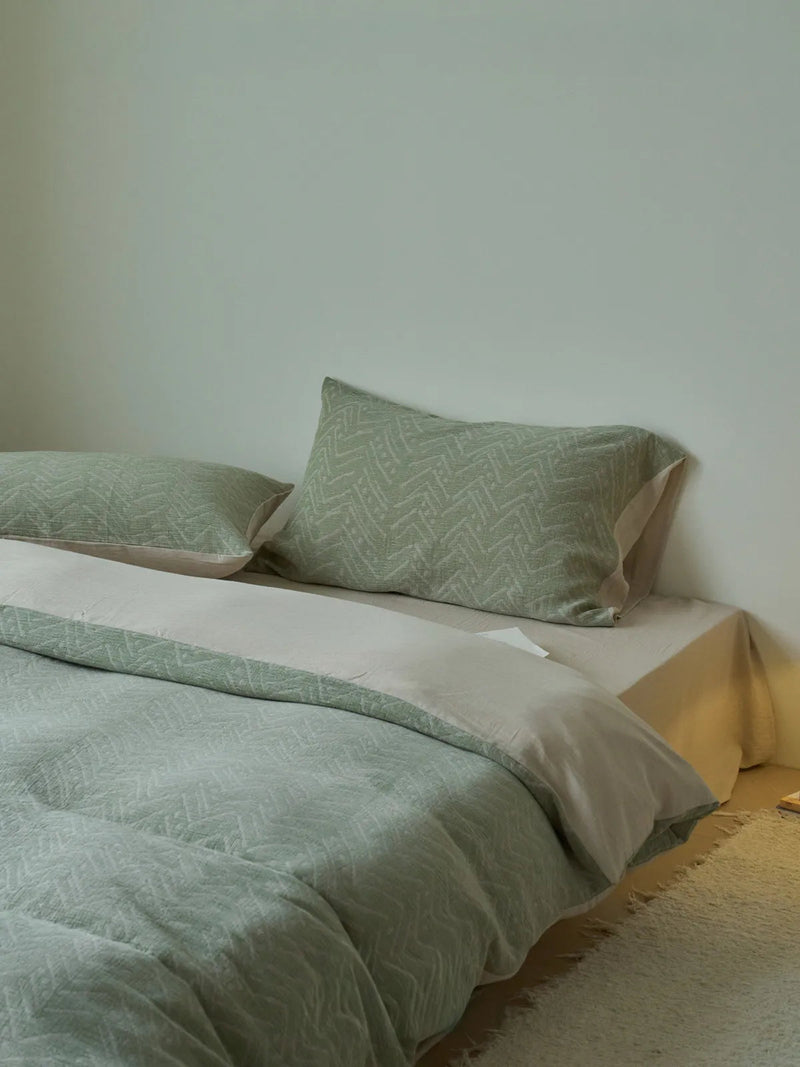
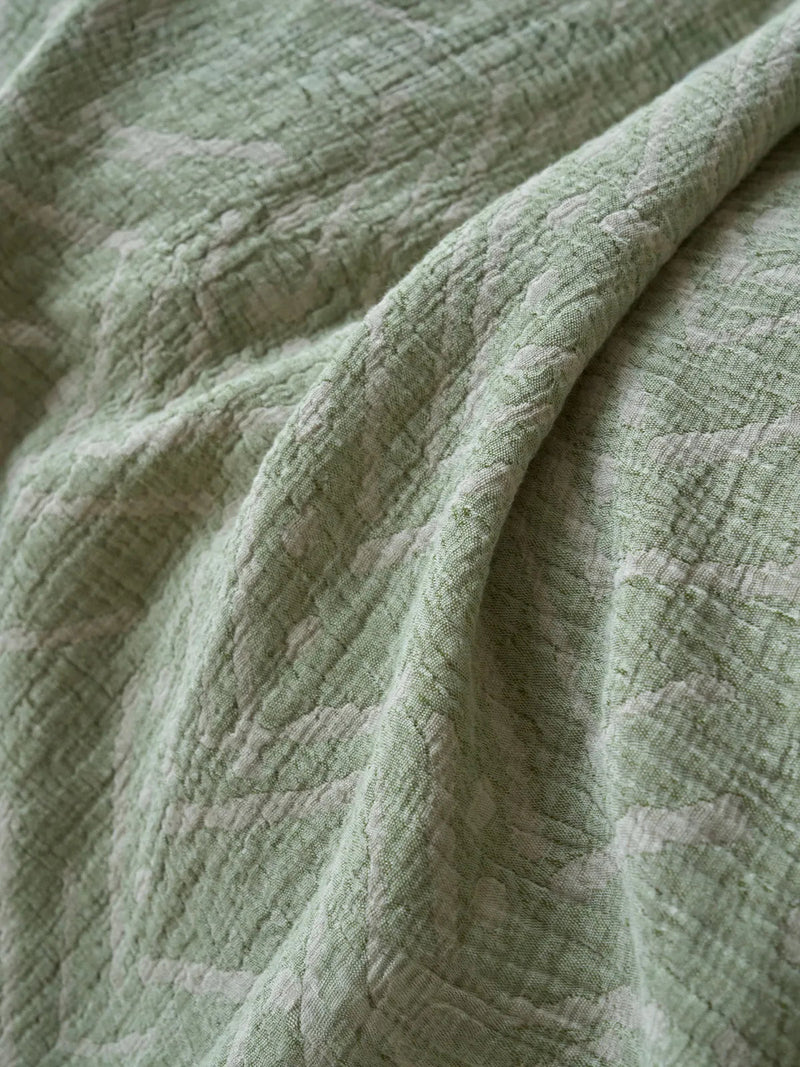
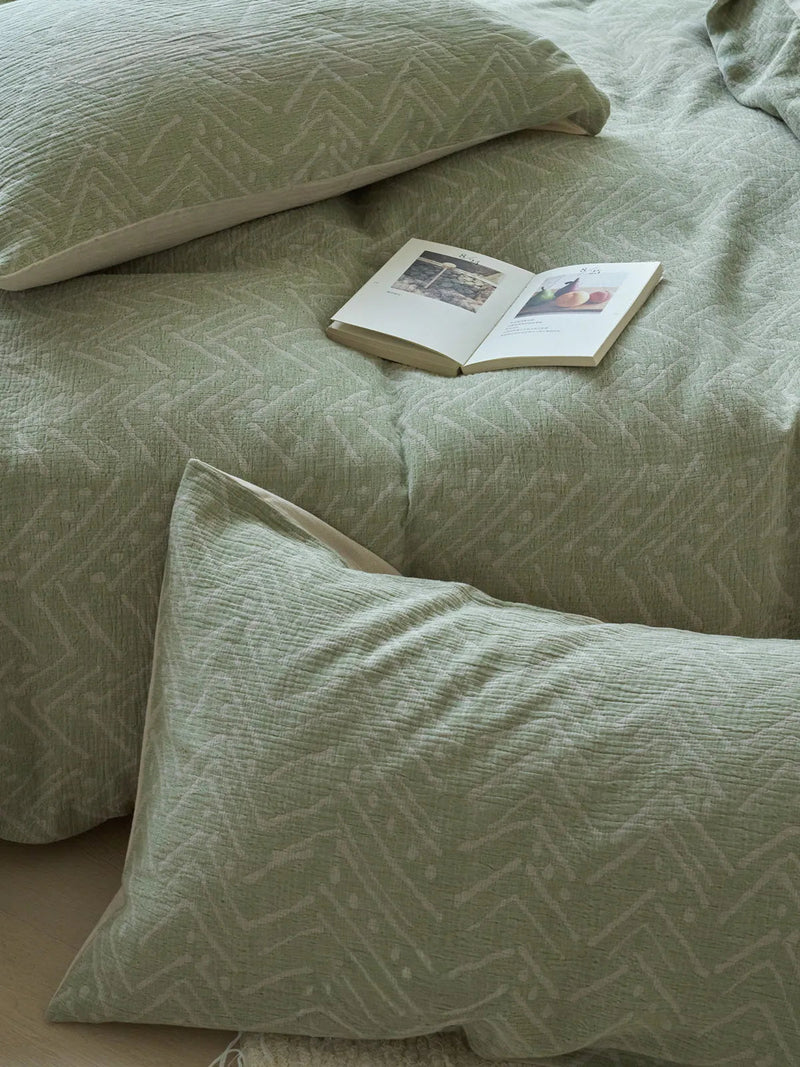
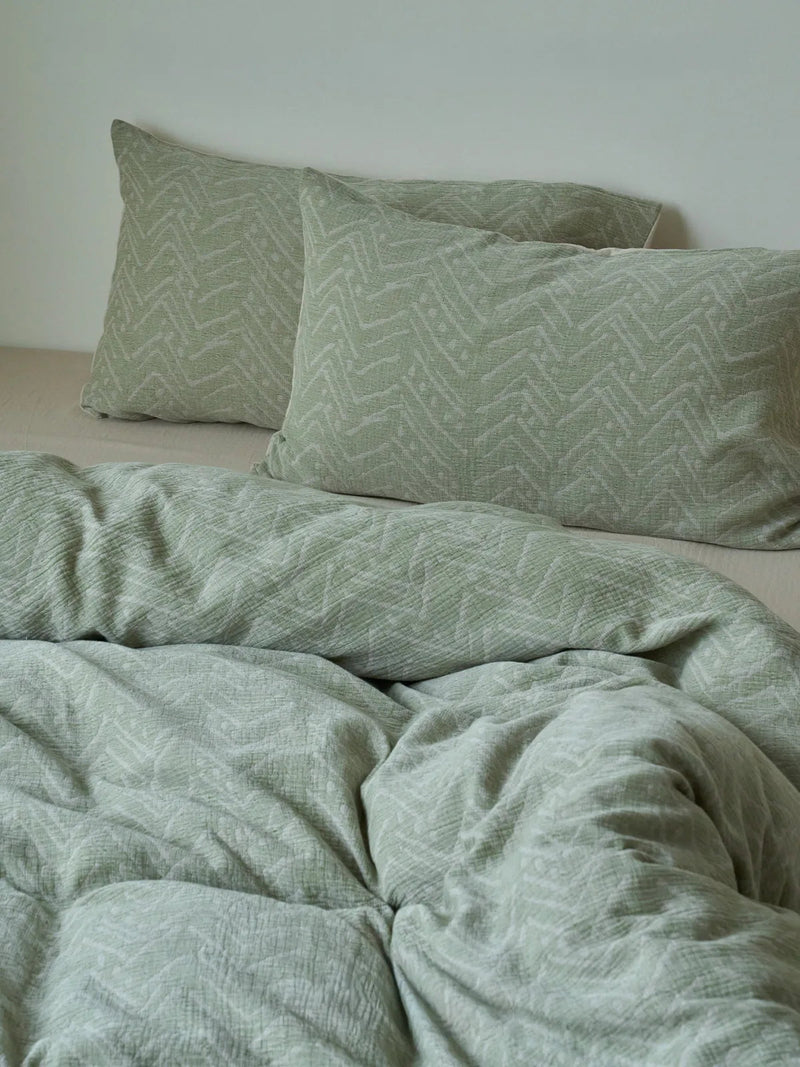
When I stripped that bed back and started over, I built it around our Soft Crinkled Geometric Washed Cotton Bedding Set as the base, and the room came back to life almost immediately. People clock the sage green first, but flip the duvet and the underside is a soft beige, and the crinkle finish drinks warm light, so around golden hour the whole set turns the colour of toast crust. That's exactly what a base should do: carry a quiet warm neutral across the largest surface without shouting, and give every smaller piece a steady field to belong to. Pick the base first and you've already done the hardest job in the room.
The piece that was lying about its job
With a real base in place, the second failure on that muddy bed finally showed itself. The cool grey throw I'd thrown on, the one I'd grabbed because it was nearby, was a different temperature from everything under it. One clouded grey object sitting on a whole warm bed, and the eye reads that mismatch as dirt even when nothing is technically wrong. The throw wasn't a bad throw. It was a good throw doing a job it didn't fit, on a bed it didn't belong to.
So the second job is simply honesty about temperature: does this smaller piece actually match the base, or did it just happen to be in the room? I pulled the grey throw, the bed snapped into focus, and the fix cost nothing but noticing. This is the single most common rescue I make on set, and it's never the beige that's the problem. It's one stray piece quietly arguing with the rest.
The honest version goes further: not everything we make is built to be the calm, and pretending otherwise would be the real lie. The blush-pink and dusty-lavender colourways of our fleece set, or the black-and-white abstract animal print, are gorgeous, but they are statement pieces, not background. If you're chasing the soft, warm calm in this guide, those are the accent you add on purpose, never the base, and we'd never pretend a cow-print fleece is beige just because it photographs cosy.

Giving the eye one edge to land on
Here's the failure I didn't even know I had until the bed was calm: it was so soft it went sleepy. Once every piece agreed and the muddiness was gone, the rebuilt bed read peaceful but slightly amorphous, like a cloud with no horizon. A neutral room needs one place for the eye to land, or it drifts off the bed entirely. The third job is an edge.
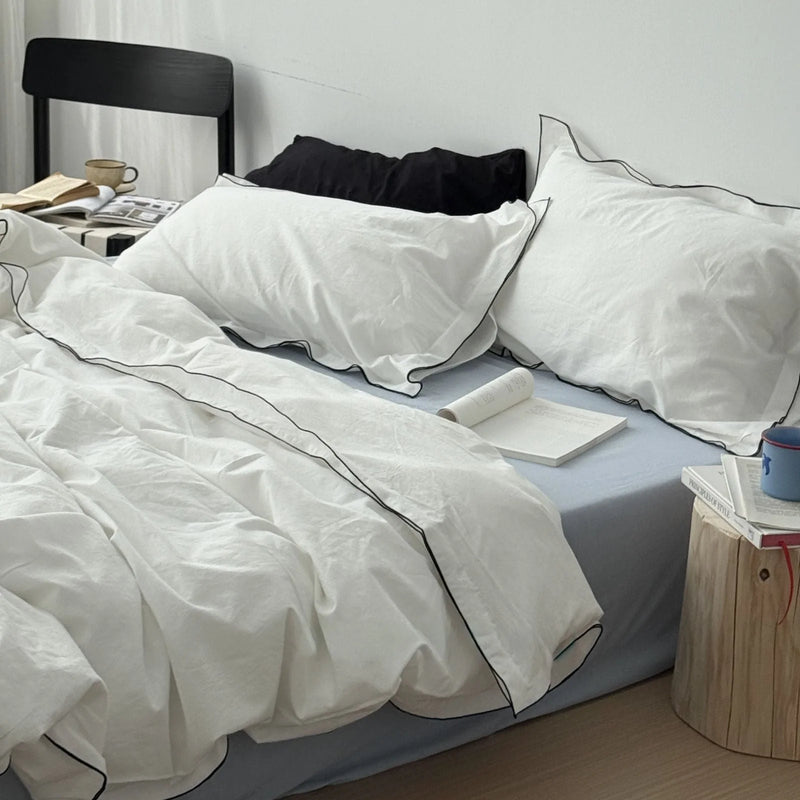
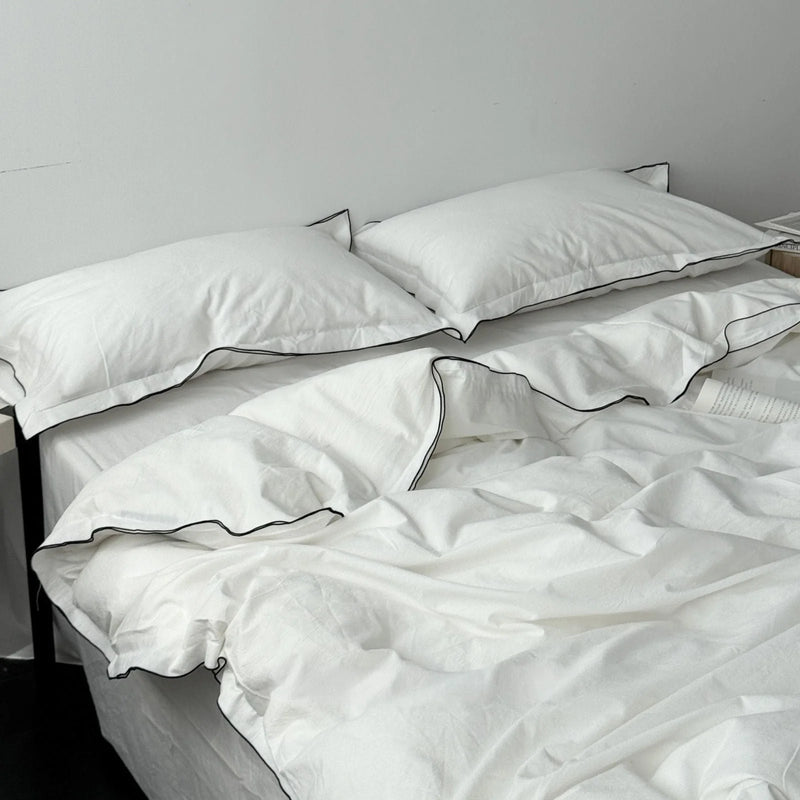
The cleanest fix I have for this is a defined line rather than a second colour. Our Soft Contrast Trim Washed Cotton Bedding Set is built around exactly that idea: a washed white with a thin black piping running the edges and the ruffle, and that single dark line is what stops a calm bed from going formless. When I want the rescued room to feel composed instead of just inoffensive, I bring in that hard edge against a wooden side table, and the trim gives the eye a place to rest without adding a single new colour. An edge is how a neutral room stays awake.


The detail that turned it personal
By now the rebuilt bed was calm, honest about temperature, and awake. It still wasn't mine. A correct neutral room can be a little anonymous, and the last job is the one that turns a fixed bed into a personal one: a single small detail, repeated, that reads as a secret rather than a slogan.
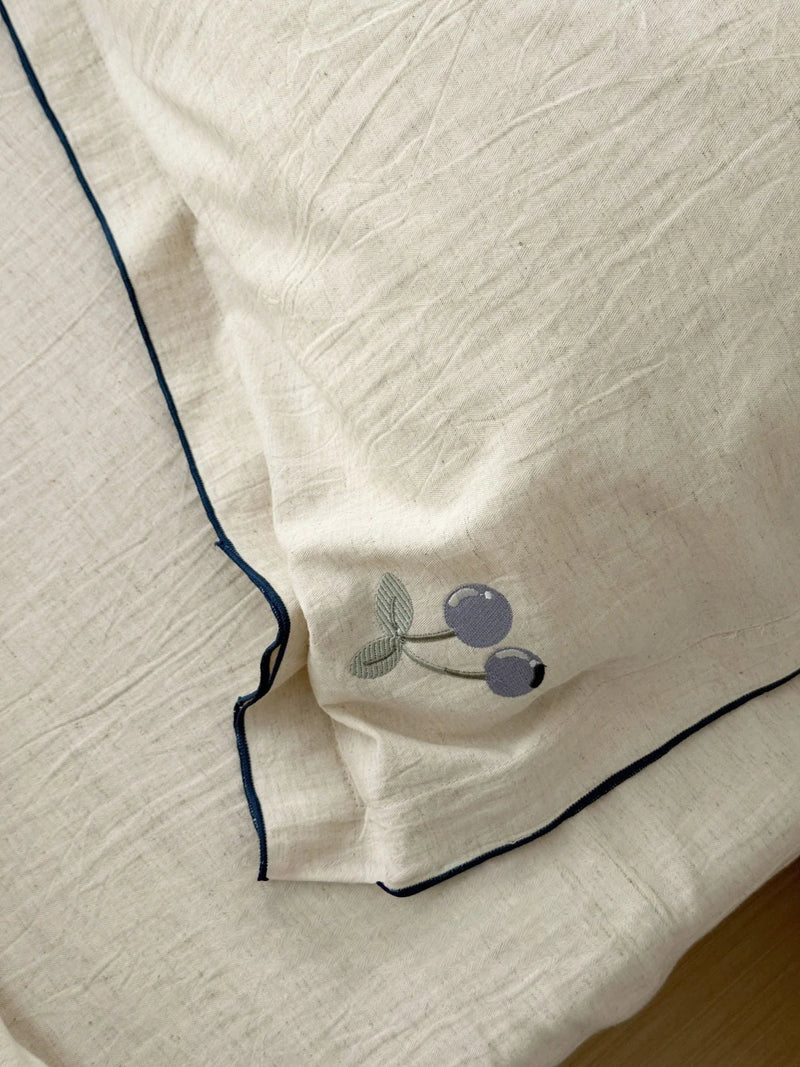
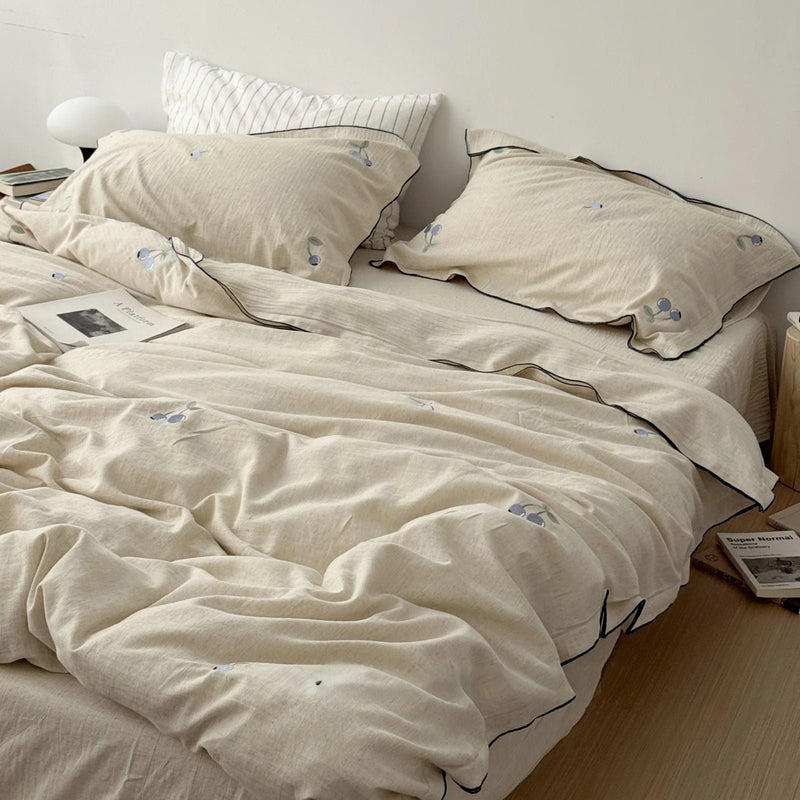
Our Textured Blueberry Embroidered Linen Bedding Set is the clearest version of this job I own. Its base is a cream linen that sits squarely in warm-neutral territory, so it never breaks the calm, and the personality lives entirely at the edges: tiny blueberry embroidery and dark piping, deliberate and repeated along the ruffle and the pillow corners. From across the room it reads as a warm neutral with a heartbeat. Up close it has a story. That's the final move on the muddy bed I started with, the one that turned a technically-correct room into one that felt like a person actually slept there: a calm base that means it, plus one detail small enough to feel like yours alone.
Counting the colour you forgot: texture
One last thing I learned from that bed, and it's the job people skip most: when you take colour off the table, texture becomes colour. Part of why that first muddy bed looked flat wasn't just the temperature drift, it was that every surface had the same dead, smooth finish, so there was nothing for light to do. A flat painted wall and a nubbly linen pillow can be the exact same shade of oat and still read as two different things, because one catches light and one swallows it.
This is why every piece I rebuilt that bed with leans washed-cotton and linen, materials that crinkle and slub and refuse to look machine-perfect. Stack two or three finishes that all sit in the same warm neutral and the bed gets depth without a single extra colour: a matte sun-warmed weave, a slubby linen, a crisper cotton on the pillows. That depth, the wabi-sabi kind that looks slightly lived-in and entirely yours, is the difference between the calm bed I rebuilt and the blank one I started with.
Rebuild your own bed, one job at a time
You don't have to start from a muddy disaster like I did. You can run the jobs in order from the beginning, and you never have to repaint a wall to do it. Choose the base and let it be calm. Check every smaller piece is telling the truth about its temperature. Give the eye one edge. Add one small detail that's only for you. Count texture as colour. Five jobs, in that order, and the calm stops being something you hope for and becomes something you assembled.
Bedding is where every one of those jobs actually lives, which is why it's the honest place to begin. Our full bedding range carries every role in that list, the warm washed-cottons and linens that make good bases, the crisp whites and contrast trims that give a room its edge, the small embroidered details that turn a correct bed into yours. Pick the piece whose job your room is missing, and the rest of the rebuild gets a lot easier, because the whole quiet thesis here is letting a space feel like you.
Written by Mara Ellison, RoomDen styling editor. We style every bedding set in our own daylight studio before it ships, which is where the muddy-bed rebuild in this guide actually happened. Last updated June 2026.


