
Coastal Vases to Style a Breezy Bedroom Shelf
A quiet little guide to three coastal vases and our Tide-Line Shelf trick for arranging them, so a narrow bedroom shelf reads breezy and beach-calm without a single seashell.

The best coastal vases don't try to look like the beach. They carry the feeling of one: the way a shelf near the window catches morning light, the salt-pale colors, the sense that nothing on it is trying too hard. We noticed this the first time we styled a narrow bedroom shelf for a shoot and reached, almost by accident, for three vases that had nothing in common except a kind of weathered calm. That accident turned into a method, and this is the small collection it grew around.
If you want a breezy bedroom shelf that reads coastal without a single seashell or rope detail, you only need a few honest pieces and somewhere to let them breathe. Below are the three vases we keep coming back to, and the styling idea that holds them together.
Contents
The Tide-Line Shelf (Our Coastal Framework)
Walk down to any beach and the most beautiful part isn't the water or the sand. It's the line between them: the strip where the tide pulls back and leaves a band of darker, wet sand, then a band of pale dry sand, then the loose drift of shells and rattan and bleached wood the sea forgot to take. We borrowed that for shelves. We call it the Tide-Line Shelf, and it's the simplest way we know to make coastal vases feel intentional instead of scattered.
The idea is to give your shelf three zones, left to right, the way the tide leaves three bands. The dry edge holds the warmest, most textured piece, the woven and worn one that feels like driftwood at the top of the beach. The waterline holds something tinted, sea-glass colored, where warm meets cool. The wet edge holds the clearest, most reflective piece, the one that catches light like a tidepool. You're not matching the vases. You're letting them grade from warm to cool, dense to clear, the way a real shoreline does.
It sounds fussy written down. In practice it takes about thirty seconds and it solves the hardest part of styling a coastal shelf: knowing where each thing goes. Once we started thinking in tide lines, our own shoots stopped looking like a row of unrelated objects and started looking like a breeze moved through them. Here are the three vases, mapped to the three bands.

Woven & Worn: The Dry Edge
Start the shelf where the beach starts drying out. The dry edge wants the most texture and the most warmth, something that looks sun-faded and hand-touched rather than glossy. This is the anchor that keeps the whole arrangement from tipping cold, which is the trap most coastal shelves fall into.
Handwoven Rattan & Glass Bud Vase
How do you get the salt-bleached, beach-house warmth without a single literal beach prop? You reach for woven rattan over a slim glass insert. The Handwoven Rattan & Glass Bud Vase is the piece we use to set the temperature of the whole shelf. The rattan reads like the loose drift at the top of a beach, the part the tide never reaches, and the hidden glass tube means it actually holds water for a single stem.

It comes as a set of three sizes, which is half the reason it earns its spot at $49. You can cluster all three at the dry edge and let them step up like dunes, or scatter one to each zone of the shelf as a quiet visual thread tying the bands together. We did the latter for a recent shoot and it's the trick we'd recommend first: the matching rattan turns three different vases into one family.
How we pair it on a shelf
In our own daylight studio we set the medium rattan vase on a round woven tray with a small white teapot beside it, one dried grass stem leaning out, and shot it at about nine in the morning when the window light is still low and long. The thing we didn't expect: from three feet back the rattan almost disappears into the tray and reads as one soft, warm mass, which is exactly what you want at the dry edge. Up close the weave is all texture. That double reading, soft from across the room, tactile up close, is the whole reason this piece anchors the warm end so well.


Sea Glass & Smoke: The Waterline
The middle band is where warm meets cool, and it's the one most people skip. They jump straight from rattan to clear glass and the shelf splits into two halves that don't talk to each other. The waterline is the bridge. It wants tinted glass: smoky grey or soft amber, the color of sea glass that's been tumbled smooth, holding a little warmth and a little cool at once.
Minimalist Tinted Oval Glass Vase
Which piece does this job without shouting? The Minimalist Tinted Oval Glass Vase comes in smoky grey and amber brown, and the tint is the entire point. Where the rattan is opaque and warm, this glass is translucent and cool-leaning, so it sits naturally between the dry edge and the wet edge and stops your shelf from reading as two unrelated piles.
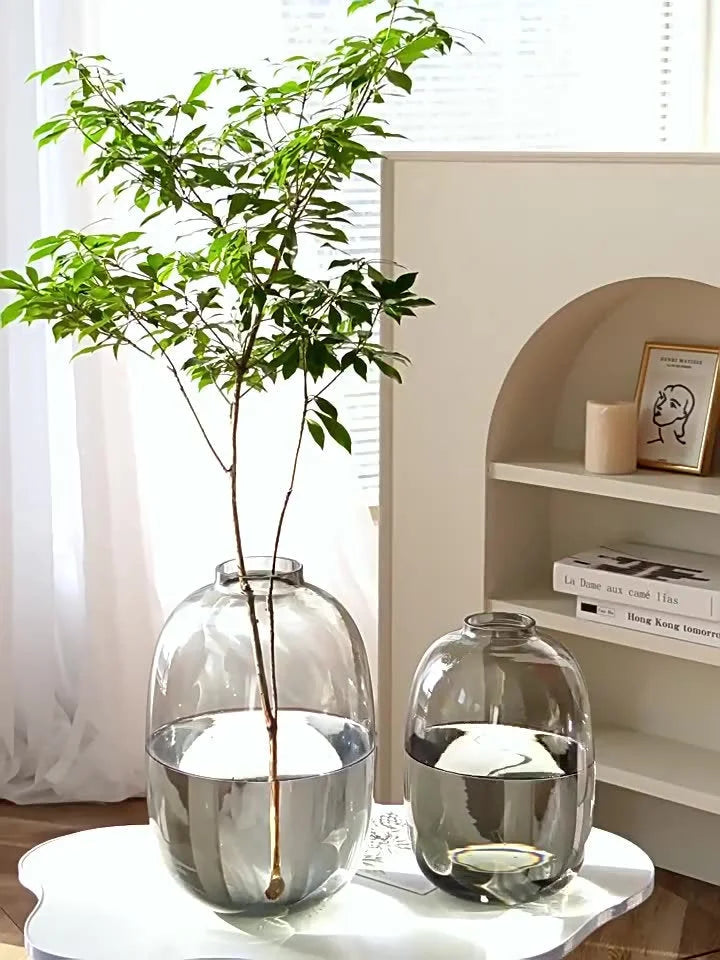
At $59 it's the most considered piece of the three, and it comes in two sizes so you can stand a tall one and nest a short one beside it. We like the smoky grey for a cooler, more Japandi-leaning bedroom and the amber for rooms that already run warm. Either way, put a single green branch in the larger one and leave the small one empty. The empty vessel is doing real work here, which brings us to the part people get wrong.
Why tinted glass reads coastal (and why empty is fine)
Coastal isn't blue and white. It's light. Tinted glass reads coastal because it does what shallow water does: it changes color as the light moves across it through the day. On a bedroom shelf that means the vase is never quite the same twice, grey at noon, almost gold at sunset. That quiet shift is the breeziness people are actually chasing when they search for coastal vases.
And the empty one matters. In the Japanese aesthetic of Ma, the negative space is the point, not the leftover. An empty tinted vase isn't an unfinished vase. It's a held breath, a bit of stillness that makes the filled ones feel intentional. Leave room on the shelf. The pause is the coastal part.

Clear & Crumpled: The Wet Edge
The wet edge is the band the tide just left, dark and bright and full of reflection. On the shelf it's the clearest, most light-catching piece, the one that acts like a tidepool and bounces the window back into the room. End your shelf here and the eye travels warm to cool, dense to clear, and lands on light.
Sculptural Crumpled Glass Vase
What stops clear glass from looking flat and cheap at the bright end? Surface. The Sculptural Crumpled Glass Vase is pressed into soft, irregular folds, so instead of one dull reflection it throws a dozen small ones, the way sun scatters across wet sand. It's the wabi-sabi piece of the set: deliberately imperfect, no two facets the same, and the most quietly interesting of the three at just $39.

It comes in clear, frosted, and iridescent. For a breezy bedroom shelf we reach for the clear or the frosted, both of which keep the wet edge feeling airy. The iridescent one is gorgeous but it pulls toward a different, more jewel-toned mood, so we save it for rooms that want a single shimmer rather than a calm shoreline. Pop a couple of stems in the large one, leave the small one bare, and let it be the brightest thing on the board.


What Goes In Them
Coastal stems are where good shelves quietly go wrong. The instinct is to fill every vase, and the result reads more florist than foreshore. Our rule from styling these for our own shoots: fill one vase per zone, leave the rest empty, and keep the stems dry and pale.
For the rattan piece, a single dried grass or a bleached wheat stem, nothing that competes with the weave. For the tinted vase, one green branch with space around the leaves, eucalyptus or a slim olive sprig. For the crumpled glass, a couple of soft stems, dried or fresh, low enough that the folds in the glass still read. Pampas is the obvious coastal choice and it works, but a single piece of curly willow does the windswept thing with more restraint. Across all three, pale and dry beats bright and lush every time you're going for breezy.
If you want to go deeper on stem-and-vessel pairing, the Wabi-Sabi tradition of valuing the worn and the incomplete is a good rabbit hole; the Met's primer on wabi-sabi is a calm, non-commercial place to start.
Start With One Vase
You don't need the full Tide-Line Shelf on day one. The honest way in is one vase, the one whose texture you already keep reaching for, set somewhere the morning light hits it. Live with it for a week. The other two zones tend to suggest themselves once you see how the first one moves with the light.
When you're ready to build the rest of the shelf, all three of these live in one place, alongside the other vessels we've shot in our own studio. Browse the full set and see which one wants to be your dry edge.


Looking for more vessels to round out the shelf? The whole lineup lives in our Vases & Vessels collection, all shot the same way in the same light, so anything you add to the tide line already belongs.
Written by the RoomDen styling desk. We style every vase in our own daylight studio before it ships, usually on the same narrow bedroom shelf you see in these shots. Last updated June 2026.


